
Reviewed by Dr. Smrithi Bhagiratha
MBBS, MD (Pediatrics)
Fellowship in Pediatric Genetics
Introduction
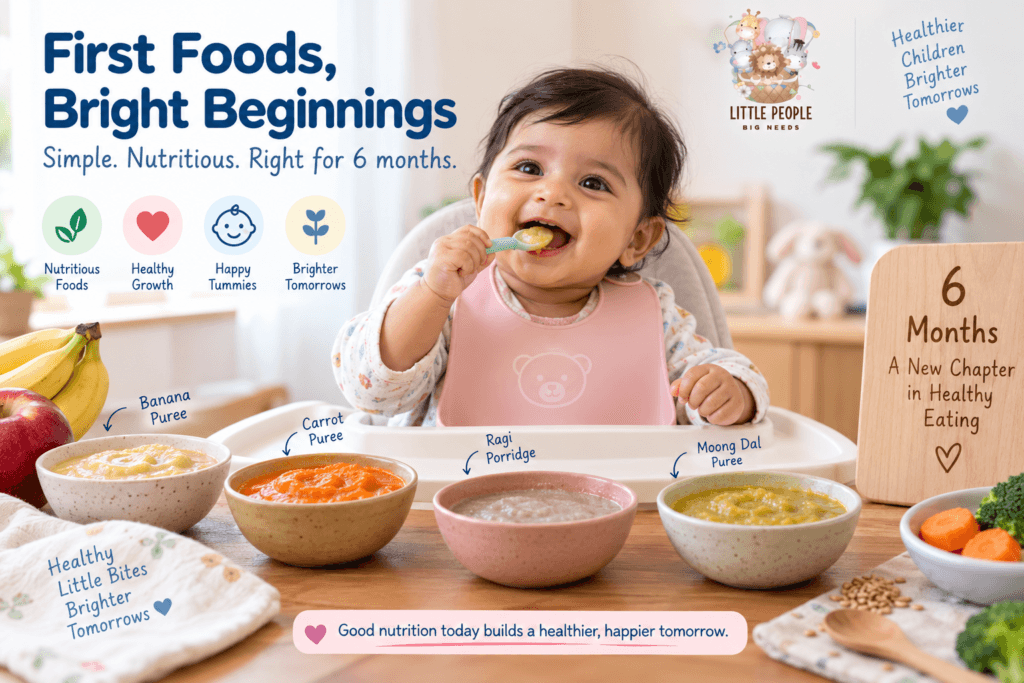
Around 6 months, most babies are ready to start solids alongside continued breastfeeding or formula. A simple starting chart looks like this: begin with single-ingredient, iron-rich purees like ragi (finger millet) porridge or moong dal water, offered once a day for the first week; move to a smooth vegetable or fruit puree by week two; introduce a second daily meal and simple two-ingredient combinations by week three; and settle into a steady rhythm of two small meals a day by week four, alongside breast milk or formula, which remains your baby’s main source of nutrition through the first year. Below, we walk through exactly how to do this safely, with a week-by-week Indian food chart, allergen guidance, and the handful of foods to avoid before age one.
Signs Your Baby Is Ready for Solids
Age (around 6 months) is the starting point, but readiness is confirmed by what your baby can actually do:
- Sits with minimal support and can hold their head steady
- Shows interest in food watching you eat, reaching for your plate
- Has lost the automatic “tongue-thrust” reflex that used to push solid objects back out of the mouth
- Can move food to the back of the mouth and swallow, rather than only spitting it out
- Can open their mouth for a spoon and close their lips around it
If your baby is close to 6 months but not quite showing these signs, that’s typical for this age there’s no need to rush, and a short delay of a few weeks is not a cause for concern. If you’re unsure, it’s a reasonable thing to bring up at your next visit.
The Golden Rules Before You Start
- Breast milk or formula stays primary through the first year. Solids at 6 months are about introducing tastes, textures, and nutrients not replacing milk feeds yet.
- One new food at a time, given for 3 days before introducing the next, so you can identify the cause if a reaction occurs.
- Start thin and smooth, and thicken gradually over the coming weeks as your baby gets used to swallowing solids.
- No added salt or sugar in any food before 1 year a baby’s kidneys aren’t ready for the salt load, and there’s no nutritional need for added sugar at this age.
- Iron-rich foods matter early, since a baby’s iron stores from birth begin to run low around 6 months. Ragi, dal, and (once introduced) egg and well-cooked meat are useful sources.
A Sample Week 1 Day
Time | Feed |
|---|---|
Morning | Breastmilk/formula |
Mid-morning | 1–2 teaspoons of a single-ingredient puree (e.g., ragi porridge or mashed banana) |
Afternoon | Breastmilk/formula |
Evening | Breastmilk/formula |
Night | Breastmilk/formula |
This is deliberately light the goal in week one is simply practice, not volume.
Weekly 6-Month Indian Food Chart
Week | What to introduce | Texture | Frequency |
|---|---|---|---|
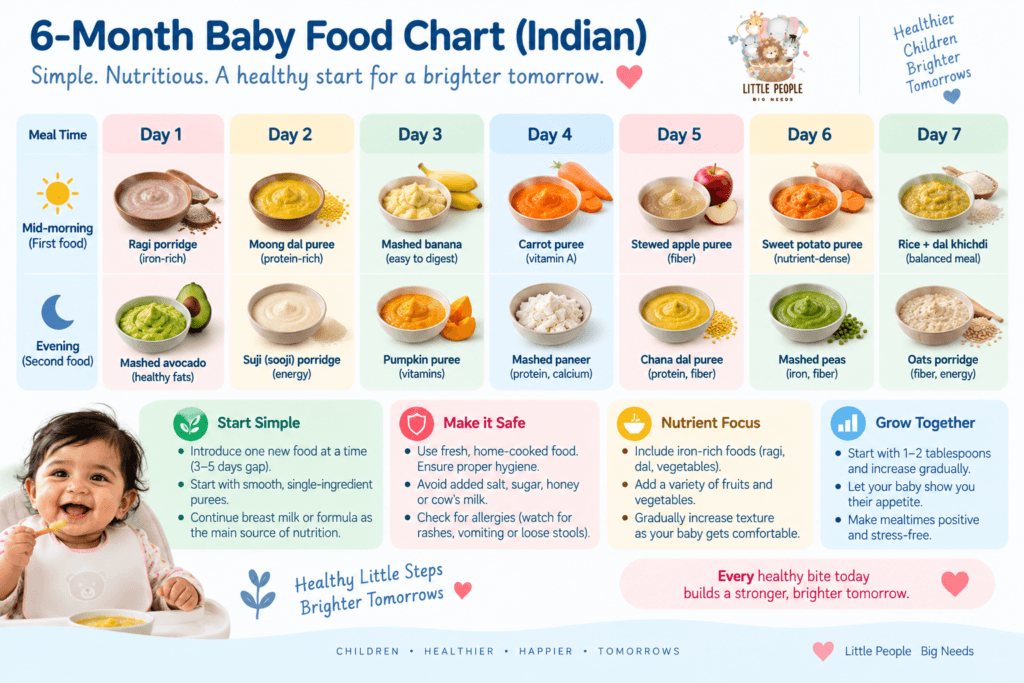
Week 1 | Single-ingredient purees: ragi porridge, moong dal water, mashed banana, or stewed apple | Thin, smooth puree | Once a day, 1–2 teaspoons, working up to 2–3 tablespoons |
Week 2 | Add: mashed sweet potato, mashed pear, pumpkin puree, khichdi water | Slightly thicker puree | Once a day, gradually increasing quantity |
Week 3 | Introduce simple two-ingredient combinations (e.g., ragi + banana, dal + rice water); begin a second daily meal | Thicker, slightly mashed | Twice a day, small portions |
Week 4 | Continue combinations; introduce well-cooked, mashed dal-rice khichdi as a main meal | Soft mashed texture with slight lumps as tolerated | Twice a day, settling into a routine |
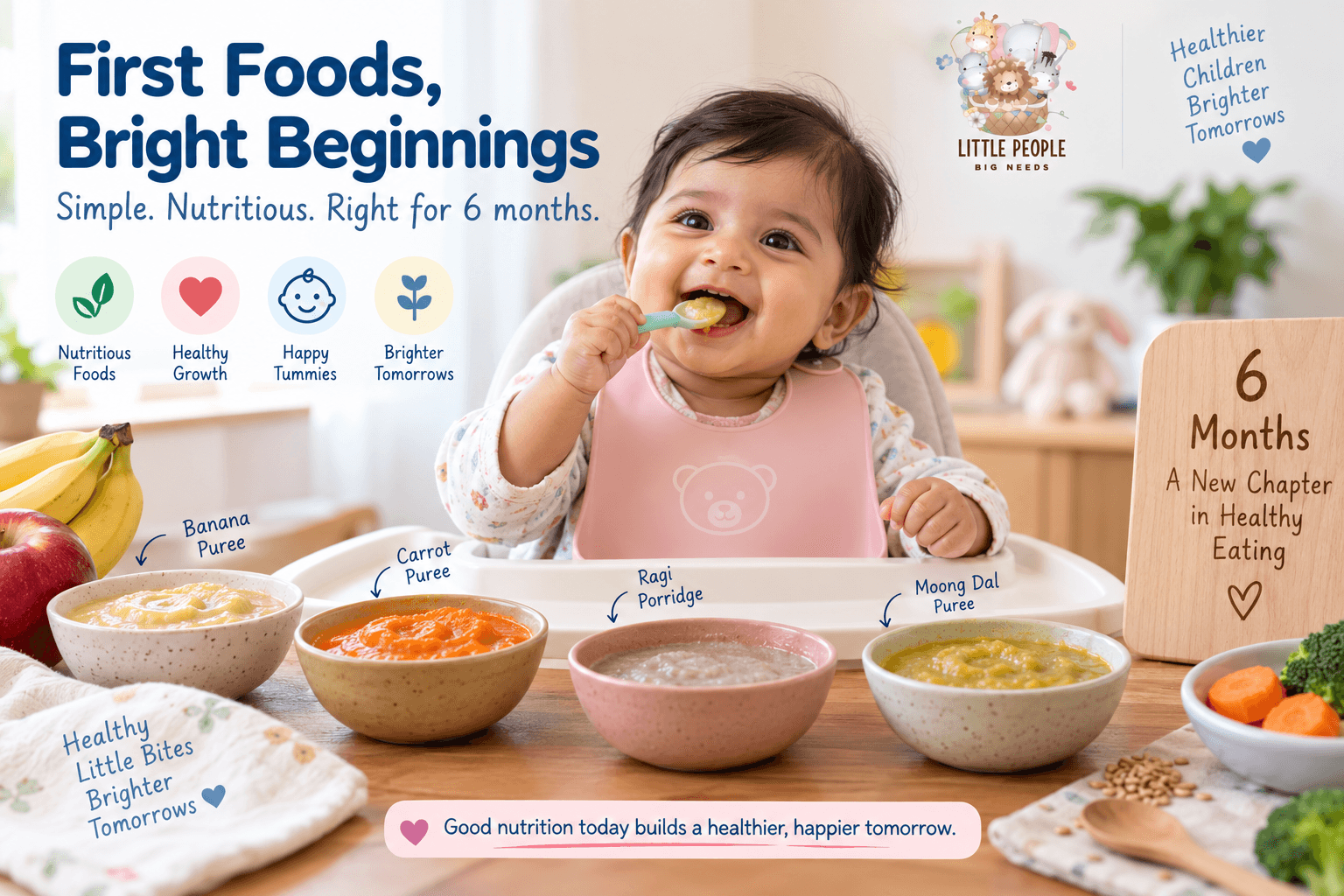
Ragi (finger millet) porridge, moong dal water, and mashed fruits like banana, apple, and pear remain reliable, gentle first foods across Indian households for good reason they’re easy to digest, mildly sweet, and nutrient-dense.
First Fruits, Vegetables & Grains
Fruits: Banana, apple (steamed and mashed), pear, and papaya are excellent early choices naturally sweet, soft, and gentle on digestion. Introduce one at a time, always cooked/steamed for firmer fruits and mashed to a smooth consistency at this stage.
Vegetables: Sweet potato, pumpkin, bottle gourd (lauki), and carrot, all well-cooked and mashed or pureed, are commonly used first vegetables in Indian households.
Grains: Ragi porridge, rice water/well-cooked rice porridge, and moong dal water are traditional, iron- and nutrient-supportive first grains, and khichdi (rice + moong dal, well-cooked and mashed) becomes a versatile main meal from around week 3–4.
Introducing Allergens Safely
Current guidance has shifted from delaying common allergens to introducing them early and gradually, once your baby is comfortably tolerating basic purees. Egg (well-cooked, starting with a small amount of yolk or well-cooked whole egg) can typically be introduced from around 7–8 months, and other common allergens can be introduced one at a time, in small amounts, watching for any reaction over the following 2–3 days (rash, vomiting, unusual fussiness, or in rare cases, swelling or difficulty breathing, which needs immediate medical attention). If your family has a history of food allergies, or you’re anxious about a specific food, it’s worth discussing the introduction plan with us directly rather than guessing.
Texture Progression
Move from thin purees (week 1) to thicker mashes with slight texture (by week 4), and continue progressing toward soft finger foods and more varied textures over the following months, as we cover in our 7-month and 8-month Indian food chart guides. Babies generally handle texture changes better when introduced gradually and often rather than left too smooth for too long, which can make the later transition to finger foods and family food harder.
Foods to Avoid Before 1 Year
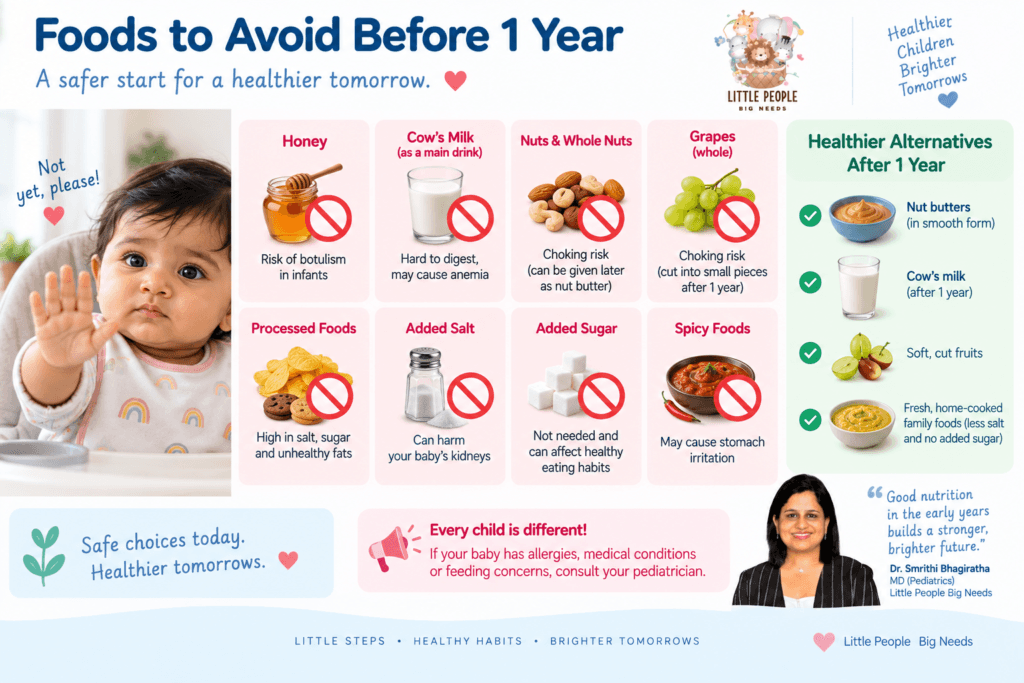
- Honey risk of infant botulism before age 1
- Cow’s milk as a main drink can be used in small amounts within cooking from around 6 months in some traditions, but should not replace breast milk/formula as the primary drink before 1 year
- Added salt a baby’s kidneys cannot process it the way an adult’s can
- Added sugar and jaggery in large amounts no nutritional need, and it shapes taste preference early
- Whole nuts, popcorn, whole grapes, raw carrot chunks choking hazards; introduce nuts only as fine, smooth butter or ground powder, never whole
- Unpasteurised dairy or juice
Portion, Frequency & Continuing Breastfeeding
At 6 months, expect small quantities a few teaspoons growing to 2–3 tablespoons per meal by the end of the month is typical, and appetite varies genuinely from baby to baby. Breast milk or formula should continue on demand throughout this period; solids at this age are a complement to milk feeds, not a replacement. By around 7 months, most babies move to two solid meals a day, which we cover in detail in our 7-month Indian baby food chart.
When to Book a Nutrition Consultation
Starting solids is usually straightforward, but it’s worth a consultation if your baby shows no interest in solids by 7 months, has a strong gag or refusal with most textures, has a family history of significant food allergies, was born preterm (timing may need adjusting), or if weight gain has been a concern alongside the transition to solids. At Little People Big Needs, feeding is reviewed as part of your baby’s whole-child care at every visit not just when something feels wrong.
Frequently Asked Questions
What foods can I give my 6-month-old baby?
Start with single-ingredient, iron-rich purees such as ragi porridge, moong dal water, mashed banana, or stewed apple, offered once a day and gradually increased. Introduce one new food at a time and continue breast milk or formula as the primary source of nutrition.
Is a 6-month Indian baby food chart safe?
Yes, when it follows core safety rules: no added salt or sugar, one new food introduced at a time, smooth textures thickened gradually, and breast milk or formula kept as the primary feed. Always adjust the pace to your baby’s individual readiness and consult your pediatrician if your baby was born preterm or has specific health concerns.
Which fruits are best for a 6-month-old?
Banana, steamed and mashed apple, pear, and papaya are excellent first fruits—naturally soft or easy to soften, mildly sweet, and gentle on digestion. Introduce one fruit at a time and watch for any reaction over the following 2–3 days.
How do I start solids for my baby?
Begin with a single-ingredient, thin puree once a day, given after a milk feed when your baby isn’t overly hungry or overly full. Increase quantity and texture gradually over the following weeks, moving toward two meals a day by around 7 months.
Which foods should I avoid for babies before 1 year?
Avoid honey (infant botulism risk), added salt, added sugar, cow’s milk as a main drink, whole nuts or other choking hazards, and unpasteurised dairy or juice. Introduce nuts only as a smooth, fine butter or powder, never whole.
How much solid food should a 6-month-old eat?
Expect small amounts at first—a few teaspoons in week one, gradually increasing to about 2–3 tablespoons per meal by the end of the month. Appetite varies between babies, and breast milk or formula remains the primary source of nutrition at this stage.

Concerned About Your Child’s Health?
Every child is different. If you have questions about your child’s symptoms, growth, development, nutrition, or overall health, our paediatric team is here to help.
Talk to Our Paediatric Team