
Reviewed by Dr. Smrithi Bhagiratha
MBBS, MD (Pediatrics)
Fellowship in Pediatric Genetics
Introduction
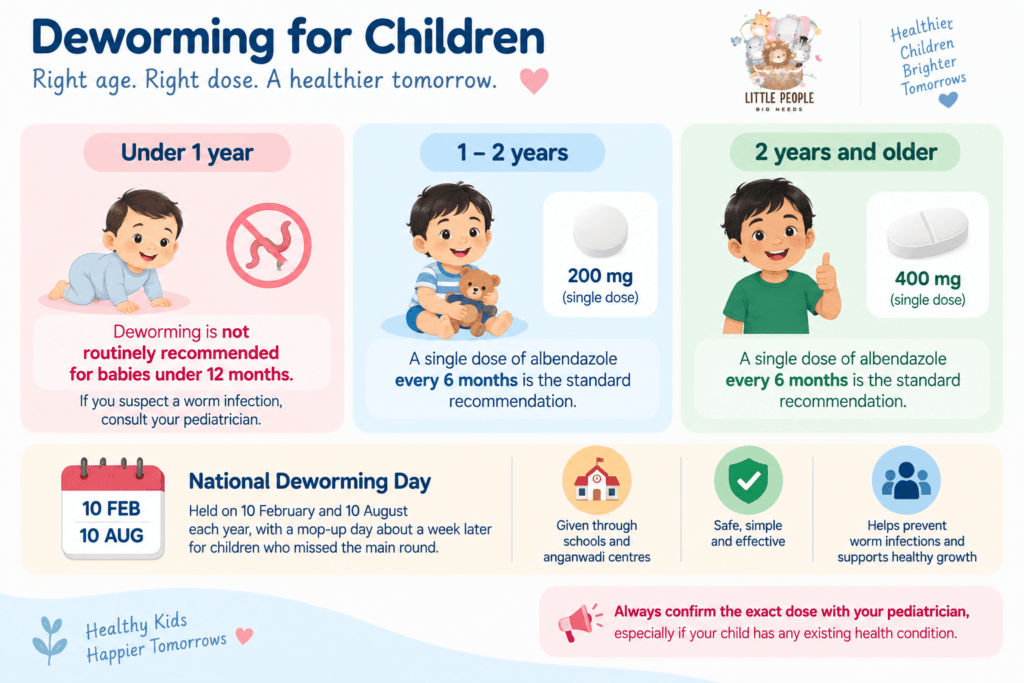
Most healthy children in India are recommended a single dose of deworming medicine (usually albendazole) once every six months, starting from 1 year of age. Children between 1 and 2 years typically receive a 200 mg dose; children 2 years and older typically receive 400 mg. Deworming is not recommended for babies under 12 months. This aligns with India’s National Deworming Day programme, held twice a year on 10 February and 10 August, which delivers free deworming tablets to children through schools and anganwadi centres across the country. Below, we explain why this matters, exactly how the dosing works, and what’s worth knowing about safety and prevention.

Why Deworming Matters
Intestinal worm infections (helminthiasis) are extremely common in Indian children, spreading easily through contaminated soil, unwashed hands, and unclean food or water even in children who otherwise have good hygiene at home, simply because of shared play areas, school environments, and community exposure. Left untreated, worm infections can quietly affect a child’s nutrition, appetite, growth, concentration, and school performance over time, often without causing dramatic symptoms. This is why deworming in India is approached as routine preventive care for all children in a moderate-to-high-prevalence area, rather than something given only when a child shows obvious signs of worms.
The Right Age to Start, and How Often
- Under 12 months: Deworming medicine is not recommended at this age. If you suspect a worm infection in a baby under 1 year, this needs a doctor’s assessment rather than an over-the-counter dose.
- 1 year and older: A single dose of albendazole every 6 months is the standard preventive schedule for healthy children in India, aligned with the government’s National Deworming Day programme.
- National Deworming Day: Held on 10 February and 10 August each year, with a “mop-up day” about a week later for children who missed the main round. Schools and anganwadi centres administer the tablets, but the same twice-yearly schedule applies whether your child receives it through school or through us.
If your child’s school already participates in National Deworming Day, there is usually no need to duplicate the dose separately unless a gap of more than 6 months has passed, or your pediatrician has advised otherwise for a specific reason.
Albendazole Dose by Age General Guidance
Age | Standard dose | Form |
|---|---|---|
Under 1 year | Not routinely recommended | |
1–2 years | 200 mg, single dose | Syrup/suspension (chewable tablets are harder to dose accurately and pose a choking risk at this age) |
2 years and older | 400 mg, single dose | Chewable tablet or syrup, as preferred |
This is a single dose, repeated every 6 months not a daily medicine. Always confirm the exact dose and suitability with your pediatrician before giving it, particularly if your child has ever had a reaction to deworming medicine, has a chronic illness, or you are unsure of their exact age-appropriate dose.
Signs Your Child May Have Worms
Many children with worms show no obvious symptoms at all, which is exactly why routine preventive deworming (rather than waiting for symptoms) is the recommended approach. When symptoms do appear, they can include:
- Vague, recurring tummy pain, especially around the navel
- Reduced appetite, or in some cases an unusually increased appetite without weight gain
- Visible worms in stool (most commonly pinworms, which look like small white threads)
- Persistent itching around the anus, especially at night a classic sign of pinworm
- Poor weight gain or slower growth than expected over time
- Unexplained tiredness, or reduced concentration and irritability
- In some cases, mild anaemia on a routine blood test
If your child has active symptoms rather than just being due for routine deworming, it’s worth a consultation rather than assuming a standard dose will address it some worm infections need specific testing or a different medication.
Side Effects and Safety
Albendazole is generally very well tolerated in children, and the “least side-effects” reputation it has is broadly accurate. When side effects do occur, they are usually mild and short-lived occasional stomach discomfort, mild nausea, or a headache in the hours after the dose. Genuine allergic reactions are rare. If your child develops a rash, facial swelling, or breathing difficulty after a dose, this needs urgent medical attention, but this is uncommon.
A note on timing: deworming tablets can typically be given with or without food, though some pediatricians prefer them after a meal to minimise mild stomach upset follow your specific product’s instructions or your doctor’s advice, since guidance can vary slightly by formulation.
Hygiene to Prevent Reinfection
Deworming medicine clears an existing infection, but it doesn’t prevent a new one reinfection is common without supporting hygiene habits at home:
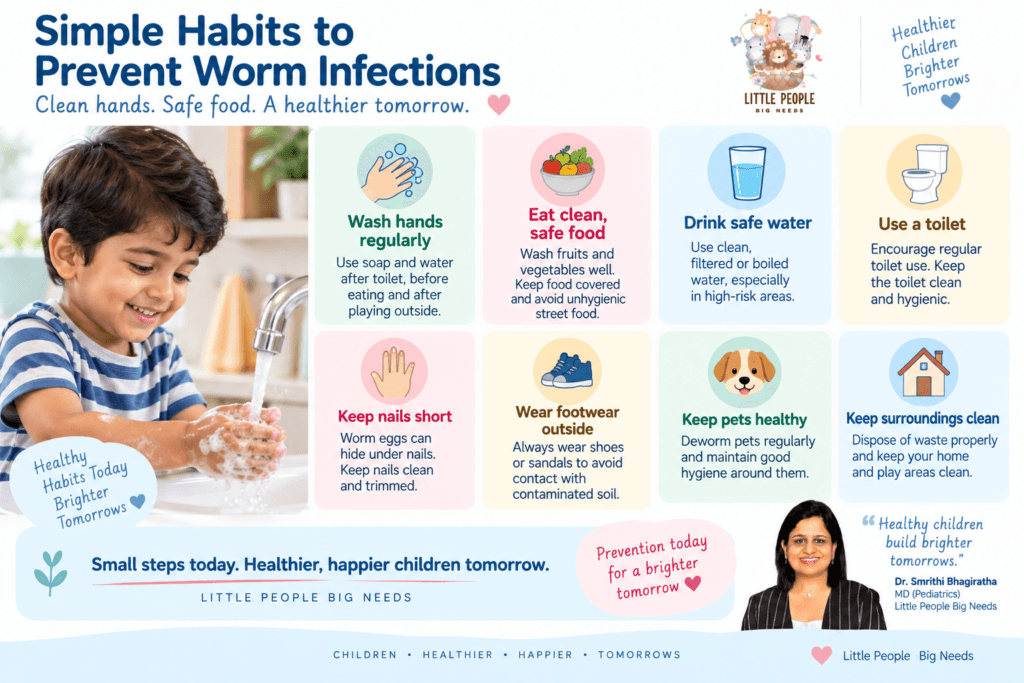
- Handwashing with soap before meals and after using the toilet, for the whole family
- Keeping fingernails trimmed short, since eggs collect under nails (especially relevant for pinworm)
- Wearing footwear outdoors, since some worm species enter through bare feet in contact with contaminated soil
- Washing fruits and vegetables thoroughly, and ensuring drinking water is clean or boiled
- Washing bedsheets and underwear in hot water during an active pinworm infection, since eggs can survive on fabric
When to See a Pediatrician Instead of Self-Dosing
Book a consultation rather than dosing at home if your child is under 1 year and you suspect worms, if your child has ongoing symptoms despite a recent dose, if you’re unsure of the correct dose for their current weight and age, or if there’s visible blood in the stool alongside suspected worms, which needs its own evaluation. At Little People Big Needs, deworming is usually a quick, straightforward part of a routine visit but we’re glad to see your child specifically for it if that’s what brings you in.
Frequently Asked Questions
At what age should I deworm my child?
Deworming is recommended starting at 1 year of age, with a single dose of albendazole every 6 months for healthy children in moderate-to-high-prevalence areas like most of India. It is not routinely recommended for babies under 12 months.
How often should children be dewormed?
Every 6 months is the standard schedule, aligned with India’s National Deworming Day, held on 10 February and 10 August each year through schools and anganwadi centres.
What is the albendazole dose for a child?
Children aged 1–2 years typically receive a 200 mg single dose, and children 2 years and older typically receive a 400 mg single dose, given once every 6 months. Always confirm the exact dose with your pediatrician for your child’s specific age and health.
What are the signs of worms in children?
Common signs include recurring tummy pain, reduced appetite, visible worms in the stool, itching around the anus (especially at night, suggesting pinworm), poor weight gain, and unexplained tiredness. Many children show no symptoms at all, which is why routine preventive deworming is recommended.
Should deworming be done on an empty stomach?
Not necessarily. Albendazole can typically be given with or without food, though some pediatricians prefer it after a meal to reduce mild stomach upset. Follow your specific product’s instructions or your doctor’s advice.
Are deworming side effects normal?
Mild side effects like brief stomach discomfort, nausea, or a headache can occur but are uncommon and short-lived. Genuine allergic reactions are rare. A rash, facial swelling, or breathing difficulty after a dose needs urgent medical attention.



Concerned About Your Child’s Health?
Every child is different. If you have questions about your child’s symptoms, growth, development, nutrition, or overall health, our paediatric team is here to help.
Talk to Our Paediatric Team