
Reviewed by Dr. Smrithi Bhagiratha
MBBS, MD (Pediatrics)
Fellowship in Pediatric Genetics
Introduction
Fever medicine is for comfort, not for treating the underlying illness and it’s usually needed when a fever is making your child genuinely uncomfortable (achy, irritable, unable to rest or drink fluids), rather than at a specific number on the thermometer. Paracetamol, dosed by your child’s weight rather than their age, is the standard first-line fever medicine for children in India. The general range is 10–15 mg per kg of body weight, given every 4 to 6 hours, with no more than 4 doses in 24 hours. Below, we walk through how that translates into an actual dose, what to do differently for ibuprofen, and the safety rules that matter more than the exact number.

Should You Medicate the Number, or the Child?
A common misconception is that fever medicine is needed as soon as the thermometer crosses 100.4°F (38°C). In practice, we think about comfort first: a child who is playing, drinking fluids, and generally themselves at 101°F often doesn’t need medicine at all. A child who is miserable, achy, and unable to settle at the same 101°F may well benefit from it. As a general guide:
- Below 100.4°F (38°C): Not usually classified as fever; monitor and offer fluids.
- 100.4–102°F (38–38.9°C): Medicate only if your child is uncomfortable, not simply because the number has crossed a line.
- Above 102°F (38.9°C), or any fever causing visible discomfort: Fever medicine is reasonable to give, alongside the home-care steps in our guide to viral fever in children.
- Above 104°F (40°C), or any fever in a baby under 3 months: This needs medical assessment the same day, in addition to (not instead of) fever medicine.
Paracetamol Dosing by Weight General Guidance
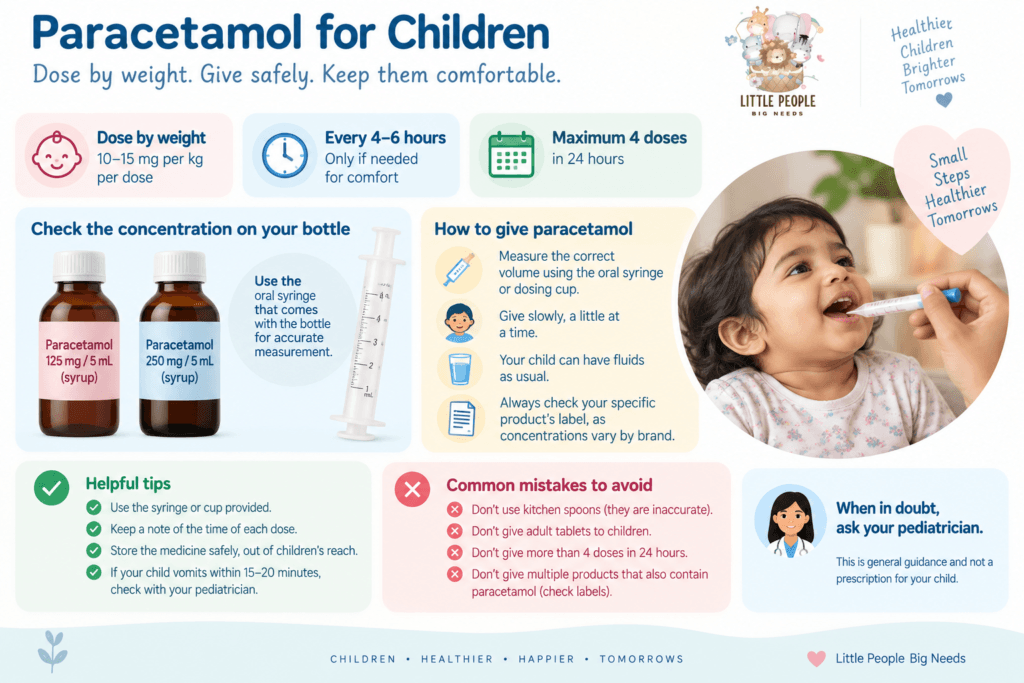
Paracetamol (acetaminophen) is dosed at 10–15 mg per kg of body weight per dose, given every 4–6 hours, with a maximum of 4 doses in 24 hours. The table below shows what that range looks like translated into millilitres for the two most common Indian paediatric syrup concentrations. Always check your specific bottle’s concentration on the label before using this table it is easy to confuse a 125 mg/5 mL infant/child syrup with a 250 mg/5 mL syrup for older children, and giving the wrong volume for the concentration you actually have is one of the most common real-world dosing errors.
Child’s weight | Dose range (10–15 mg/kg) | Volume if using 125 mg/5 mL syrup | Volume if using 250 mg/5 mL syrup |
|---|---|---|---|
5 kg | 50–75 mg | 2–3 mL | 1–1.5 mL |
8 kg | 80–120 mg | 3.2–4.8 mL | 1.6–2.4 mL |
10 kg | 100–150 mg | 4–6 mL | 2–3 mL |
15 kg | 150–225 mg | 6–9 mL | 3–4.5 mL |
20 kg | 200–300 mg | 8–12 mL | 4–6 mL |
25 kg | 250–375 mg | 10–15 mL | 5–7.5 mL |
This table is general reference information, not a substitute for your pediatrician’s guidance or your product’s own dosing instructions. Always use the oral syringe or dosing cup that came with the syrup never a kitchen teaspoon, which can be off by a significant margin in either direction. If your child’s weight or the syrup concentration you have isn’t a clean match for this table, or if you have any doubt, call us or your pharmacist rather than estimating.
Paracetamol vs Ibuprofen What’s Actually Different
Paracetamol is generally the first choice for fever in children of all ages above the newborn period, works within 30–60 minutes, and is gentle on an empty stomach.
Ibuprofen (5–10 mg/kg per dose, every 6–8 hours) is an alternative for children over 3 months, and can be somewhat longer-acting. It should always be given with food or milk, and is best avoided if dengue is suspected, since it can increase bleeding risk in that specific illness paracetamol is the safer choice whenever a mosquito-borne fever is a possibility during Bengaluru’s monsoon season.
Alternating paracetamol and ibuprofen is sometimes recommended by doctors for a stubborn fever, but it should only be done on specific medical advice, with a clear schedule, because it becomes very easy to lose track of which medicine was given when and that is exactly how accidental double-dosing happens. If your child’s fever isn’t responding to a correctly dosed single medicine, that’s a reason to be examined, not a reason to combine medicines on your own.
Common Fever Syrup Names in India What the Label Actually Tells You
Indian pharmacies stock several well-known paracetamol brands for children, typically as syrups (125 mg/5 mL for infants and young children, 250 mg/5 mL for older children) or as dispersible tablets. We’re not going to recommend one brand over another here what matters far more than the brand name is reading the concentration on the label every single time, since the same brand name sometimes exists in more than one strength, and switching between a newly bought bottle and an older one in your medicine cabinet without checking the label is a common source of dosing mistakes.
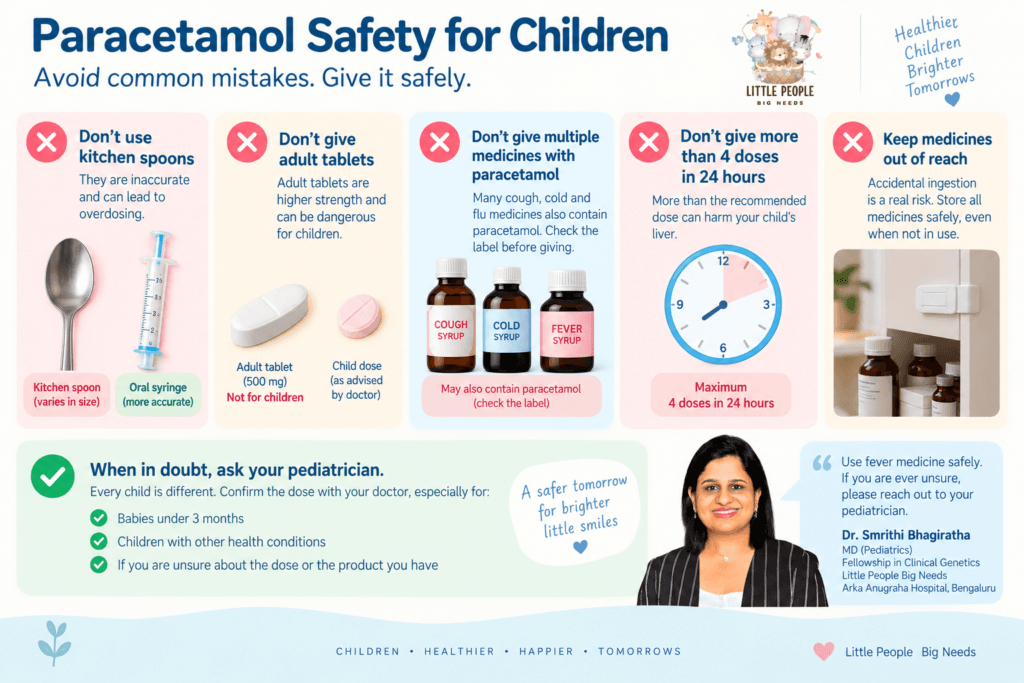
Overdose Safety What Not to Do
- Never give aspirin to a child with fever. It carries a rare but serious risk of Reye’s syndrome in children recovering from viral illness.
- Never combine two different paracetamol-containing products (for example, a fever syrup plus a cold-and-flu combination medicine that also contains paracetamol) without checking both labels this is one of the most common causes of accidental overdose.
- Never give an adult tablet split “by eye” to estimate a child’s dose. Adult paracetamol tablets are a different strength and are not designed for precise fractional dosing in children.
- Store fever medicine out of reach and out of sight between doses, ideally in a cabinet a toddler cannot climb to accidental ingestion of a whole bottle is a genuine paediatric emergency.
- If you suspect an overdose an unknown amount taken, or more than the maximum daily dose given by mistake treat it as an emergency and go straight to Arka Anugraha Hospital, even if your child seems fine. Paracetamol overdose can cause serious liver injury that isn’t obvious in the first few hours.
When Fever Needs a Doctor, Not Just Medicine
Fever medicine treats discomfort it does not treat the cause of the fever, and it will not prevent a serious illness from progressing. See a doctor the same day, regardless of how the fever responds to medicine, if your child is under 3 months old with any fever, the fever crosses 104°F (40°C), it lasts beyond 5 days, or your child shows any of the red-flag signs covered in our guide to viral fever symptoms and duration difficulty breathing, repeated vomiting, unusual drowsiness, a stiff neck, or a seizure.
A Note on Teething Fever
Teething is sometimes blamed for a fever, but teething on its own typically causes, at most, a very mild rise in temperature not a true fever above 100.4°F. A genuine fever in a teething-age baby usually has another cause and is worth evaluating on its own terms rather than assumed to be “just teeth.” We cover teething symptoms and safe relief separately in our teething guide.
When to Book a Consultation
If you’re confident in the dose, your child is comfortable between doses, and there are no red-flag signs, home management with correctly dosed paracetamol is reasonable. Book a consultation if the fever isn’t responding to correctly dosed medicine, if you’re unsure about dosing for your child’s specific weight or the concentration you have, or simply if a fever combined with medication questions is making you anxious that’s a completely reasonable reason to come in and have us walk through it with you in person.
Frequently Asked Questions
When should I give my child fever medicine?
Give fever medicine when your child is genuinely uncomfortable from the fever—achy, irritable, or unable to rest or drink—rather than at a specific thermometer number. Most children benefit from medicine once the fever crosses 102°F (38.9°C) or is causing visible discomfort at a lower reading.
How much paracetamol can I give my child?
The general dose is 10–15 mg per kg of body weight, every 4–6 hours, with a maximum of 4 doses in 24 hours. The exact volume depends on your syrup’s concentration (commonly 125 mg/5 mL or 250 mg/5 mL in India). Always check the label and use the syringe provided, and confirm with your pediatrician if you’re unsure.
Which is the best fever syrup for babies?
There is no single “best” brand—what matters is using a paracetamol syrup at the correct concentration for your baby’s age, dosed accurately by weight using the syringe provided, and only after checking with your pediatrician for babies under 3 months, since fever at that age needs same-day medical evaluation regardless of medicine given.
Can I give paracetamol and ibuprofen together?
Not on your own. Alternating the two is sometimes advised by a doctor for a stubborn fever, but only with a specific schedule, because it’s easy to lose track and accidentally double-dose. If a correctly dosed single medicine isn’t controlling the fever, that’s a reason to be examined rather than to combine medicines.
At what temperature should I worry about my child’s fever?
A fever above 104°F (40°C), or any fever in a baby under 3 months old, needs same-day medical attention. Below that, focus more on how your child is behaving between fever spikes—playful and drinking fluids is reassuring, even with a moderately high number on the thermometer.
What fever medicine is safe for a 1-year-old?
Paracetamol, dosed by weight (10–15 mg/kg every 4–6 hours), is the standard and safest fever medicine for a 1-year-old. Ibuprofen is also an option from 3 months onward, given with food. Avoid aspirin entirely, and confirm the exact dose against your child’s current weight and your syrup’s concentration.



Concerned About Your Child’s Health?
Every child is different. If you have questions about your child’s symptoms, growth, development, nutrition, or overall health, our paediatric team is here to help.
Talk to Our Paediatric Team